

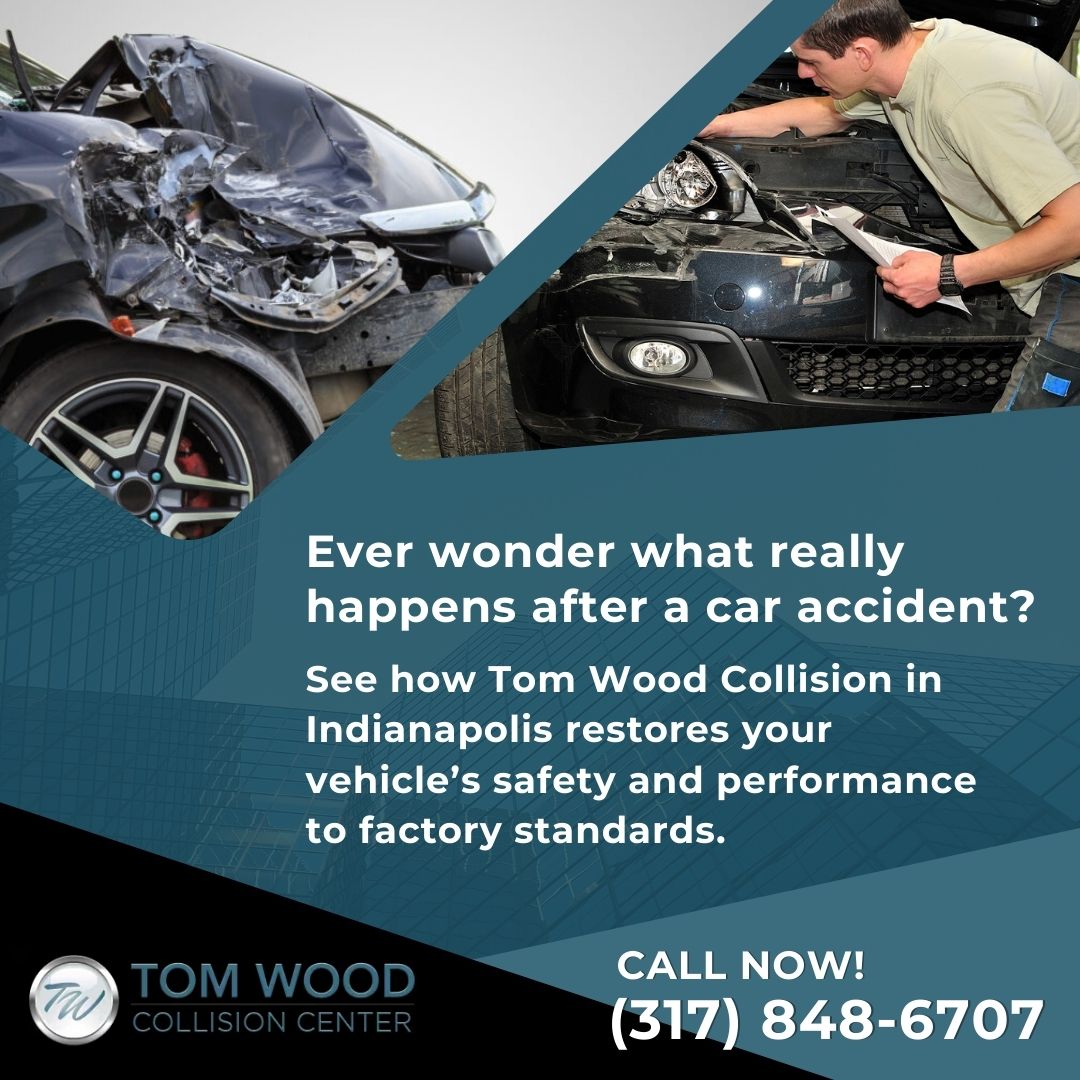
Modern collision repair involves systematic procedures that restore both appearance and safety features to factory specifications. The process typically spans 7 to 14 days, depending on damage severity, parts availability, and required safety system recalibrations.
Tom Wood Collision Center has provided trusted collision repair in Indianapolis since 2012, guiding local drivers through every step of the restoration process. Our facility holds certifications from over 20 automotive manufacturers and operates advanced diagnostic equipment that reveals damage invisible during standard inspections. This guide explains exactly what happens to your vehicle from arrival through final delivery.
What is Auto Collision Repair?
Auto collision repair restores vehicles to their pre-accident condition through structural corrections, body work, paint refinishing, and safety system recalibration. This process differs from mechanical repair by focusing on exterior damage, structural integrity, and the electronic safety systems that protect occupants during crashes.
Modern vehicles contain radar sensors, collision avoidance cameras, and engineered crumple zones that function through precise positioning. When collisions occur, these components can shift by millimeters and compromise their protective capabilities. Professional collision shops address both visible damage and these hidden safety concerns through manufacturer-specified procedures.
The process requires specialized equipment that most general repair shops lack. This includes:
- Frame measurement systems that track corrections to tolerances within fractions of millimeters.
- Paint mixing technology that matches colors across thousands of factory formulas.
- Diagnostic scanners that identify electronic system faults that produce no visible symptoms.
When searching for quality auto collision repair near you, verify that the facility has the certifications, equipment, and trained technicians necessary to properly restore modern vehicle safety systems alongside cosmetic repairs.
Initial Assessment and Documentation
Facilities begin with a detailed damage assessment that identifies all affected components, creates repair estimates, and documents vehicle condition through photographs and diagnostic scans. This initial evaluation typically requires 2 to 4 hours and establishes the foundation for all subsequent work.
Visual and Electronic Inspection
Technicians use multiple assessment methods to capture complete damage profiles. Visual inspection identifies obvious panel damage, paint defects, and structural distortions. At Tom Wood Collision, we use the UVEYE Helios system to scan vehicle undercarriages in seconds and create detailed imagery that reveals frame damage, fluid leaks, and sensor problems missed by visual inspection alone.
Pre-repair diagnostic scanning connects to your vehicle's electronic systems and retrieves fault codes from safety modules, engine computers, and sensor arrays.
Creating the Repair Plan
Estimators analyze crash patterns to predict hidden damage locations. Front-end impacts typically affect cooling systems and bumper-mounted sensors. Side collisions often damage door intrusion beams and pillar structures. This pattern analysis guides disassembly procedures and parts ordering.
Written repair plans document every procedure required to restore your vehicle. These plans follow Original Equipment Manufacturer (OEM) repair procedures specific to your vehicle's make, model, and year. Digital documentation creates permanent records for warranty coverage and future service needs.
Insurance Coordination and Authorization
Insurance coordination involves submitting damage documentation, negotiating repair coverage, and obtaining authorization before work begins. This phase typically requires 3 to 5 business days as adjusters review estimates and approve repair procedures.
Collision centers submit detailed estimates with photographs, diagnostic reports, and parts lists to insurance carriers. At Tom Wood Collision, we maintain relationships with all major insurance companies and understand their specific requirements, which streamlines approval processes. Some insurance companies request vehicle teardown before authorizing repairs to verify all damage is documented.
Authorization signatures from vehicle owners confirm agreement to proceed with repairs. In Indiana, you need only one repair estimate for insurance approval, protecting your right to choose your preferred facility.
Vehicle Disassembly and Hidden Damage Discovery
Disassembly removes damaged components to expose underlying structures and reveal damage not visible during initial assessment. Technicians systematically remove panels, trim, and damaged parts while documenting additional damage that requires repair authorization updates.
Uncovering Hidden Problems
The disassembly phase uncovers hidden problems. For example, bumper covers hide bent reinforcement bars, door skins conceal damaged intrusion beams, and quarter panels mask structural damage to the rear body sections. Each discovery requires documentation and communication with insurance adjusters.
Parts ordering begins during this phase. OEM parts come directly from vehicle manufacturers and match original specifications exactly. Delivery times vary by manufacturer, with common components arriving within 2 to 3 days while specialized parts for luxury vehicles may require 7 to 10 days.
Customer service representatives contact you immediately when technicians find additional damage, explain what was discovered, and provide revised completion estimates. Transparent communication prevents surprises and allows you to plan accordingly.
Structural and Frame Repairs
Structural repair restores your vehicle's frame to exact factory dimensions using computerized measuring systems and hydraulic straightening equipment. Frame integrity determines whether your vehicle provides the designed crash protection in future accidents.
Precision Frame Straightening
Vehicle frames are engineered to absorb and redirect crash forces away from occupant compartments. Even deviations of 2 to 3 millimeters alter crash performance and compromise occupant safety. Laser measurement systems track frame dimensions in real-time, comparing current measurements against manufacturer specifications stored in databases.
Frame straightening applies controlled hydraulic forces through specialized clamps and pulling towers. Technicians monitor measurements continuously during straightening procedures, adjusting pull angles and force levels to achieve exact tolerances.
Welding and Corrosion Protection
Welding procedures follow manufacturer specifications for heat levels, weld locations, and cooling rates. High-strength steel used in modern vehicles loses its strength properties when heated beyond specific temperatures. Certified welders understand these material requirements and use appropriate welding techniques for each steel grade.
Corrosion protection completes structural repairs. Welded areas receive primer coatings that prevent rust formation. These protective measures maintain long-term structural integrity and prevent corrosion problems that appear months later.
At Tom Wood Collision, our certified technicians use advanced frame measurement equipment to restore your vehicle's structural integrity to manufacturer specifications. Our repair process follows strict OEM procedures, giving you confidence that your vehicle's safety systems will perform as designed when you need them most.
Body Panel Repair and Replacement
Body panel work reshapes damaged metal, replaces unrepairable components, and prepares surfaces for paint application. Technicians use specialized tools that reform metal without creating weak points or stress concentrations.
Repair Techniques
Paintless Dent Repair (PDR) removes minor dents without affecting factory paint finishes. Technicians access the backside of the dent through door openings or by removing interior trim panels. PDR works effectively on shallow dents where paint remains intact and metal has not stretched beyond repair limits.
Traditional body repair involves more extensive metalwork. Technicians use hammers, dollies, and body files to reshape damaged panels. Severely damaged areas receive welded patches or complete panel replacement. Aluminum panels require different techniques than steel because aluminum work-hardens during shaping.
Surface Preparation
Panel alignment receives careful attention throughout body repair. Gaps between doors, fenders, and body panels must match factory specifications. Technicians verify alignment using specialized gauges that measure gap widths and panel heights.
Surface preparation begins after metalwork completion. Technicians apply body filler to low spots, then sand surfaces to create smooth contours. Primer-surfacer coats provide corrosion protection and fill minor surface irregularities. Final sanding creates the smooth surface required for quality paint application.
Our collision repair team specializes in both PDR and traditional body panel repairs, selecting the appropriate method based on your vehicle's specific damage. When you choose collision repair in Indianapolis with our certified technicians, you receive meticulous attention to detail that restores your vehicle's original appearance and structural integrity.
Paint Preparation and Refinishing
Paint refinishing matches your vehicle's original color exactly and applies protective coatings that maintain appearance and prevent corrosion. Modern paint systems use multiple layers that provide color, depth, and durability.
Color Matching Technology
Color matching begins with computer analysis of your vehicle's paint code. At Tom Wood Collision, we use the Sherwin-Williams Collision Core Pronto system, which stores formulas for over 100,000 vehicle colors and automatically mixes precise quantities. Our technicians create test panels and compare them against your vehicle under multiple lighting conditions to verify exact matches.
Application Process
Paint application occurs in controlled-environment spray booths that maintain specific temperature and humidity levels. Booths filter incoming air to remove dust particles that cause paint defects. Base coat provides color while clear coat layers add depth and protection.
Paint curing requires specific time periods before handling. Force-dry systems accelerate curing through controlled heating. Proper curing develops full paint hardness and chemical resistance.
Advanced Driver Assistance System Calibration
ADAS calibration aligns and electronically configures safety sensors so collision warning, automatic braking, and lane-keeping systems function as the manufacturer designed. This step is required as vehicles increasingly rely on electronic safety features.
Why Calibration Matters
Advanced Driver Assistance Systems include forward collision warning, automatic emergency braking, blind spot monitoring, and lane departure warning. These systems depend on cameras, radar sensors, and ultrasonic detectors positioned at precise locations. Modern vehicles increasingly require ADAS calibration following windshield replacement, with newer model years demanding this service far more frequently than vehicles from just a few years ago.
Calibration Methods
ADAS calibration uses two primary methods: static calibration and dynamic calibration, each serving different sensor types and system requirements. Static calibration positions vehicles in controlled environments with specialized targets and equipment. Technicians use calibration software to verify that cameras and sensors align properly with manufacturer specifications.
Dynamic calibration requires test drives under specific conditions. The vehicle must be driven on designated routes to allow systems like lane-keeping and adaptive cruise control to self-calibrate using real-world conditions.
The calibration process duration varies based on your vehicle's specific systems and how many require adjustment. Skipping ADAS calibration creates serious safety risks, as misaligned sensors may fail to detect hazards or activate at the wrong times.
Final Assembly and Quality Control
Final assembly reinstalls components, verifies all systems function properly, and subjects repaired vehicles to multi-point inspections before customer delivery. Quality control catches any issues before vehicles return to service.
System Verification
Reassembly follows reverse disassembly sequences. At Tom Wood Collision, our technicians carefully reinstall all removed parts, including interior trim, exterior moldings, lights, and mechanical components. We verify that electrical connections work properly and tighten each fastener to the correct specifications.
Diagnostic scanning after collision repairs compares your vehicle's electronic systems against the initial scan taken before work began. This identifies any issues that occurred during repairs and confirms that all systems communicate correctly.
Inspection and Road Testing
Visual inspection examines paint quality under multiple lighting conditions. Inspectors check for color match accuracy, surface smoothness, and proper clear coat application. Panel alignment receives verification using gap measurement tools.
Road testing evaluates vehicle performance under actual driving conditions. Test drives verify steering alignment, brake operation, and suspension function. Highway testing confirms stability control and collision warning systems activate appropriately. Any discovered issues receive immediate correction before customer notification.
Vehicle Delivery and Warranty Coverage
Final delivery includes repair review, paperwork completion, and warranty documentation that protects your investment. This concluding phase returns you to normal transportation while providing ongoing support.
Customer walkarounds review all completed repairs. Service advisors explain what work was performed and answer questions about repair procedures. Documentation includes itemized repair invoices, warranty information, and insurance claim paperwork.
Our service advisors provide thorough vehicle walkarounds and complete documentation for every auto collision repair, while our lifetime warranty coverage gives you long-term protection and peace of mind. Our warranty covers all work for as long as you own your vehicle.
 â
â
Tom Wood Collision: Quality Collision Repair in Indianapolis
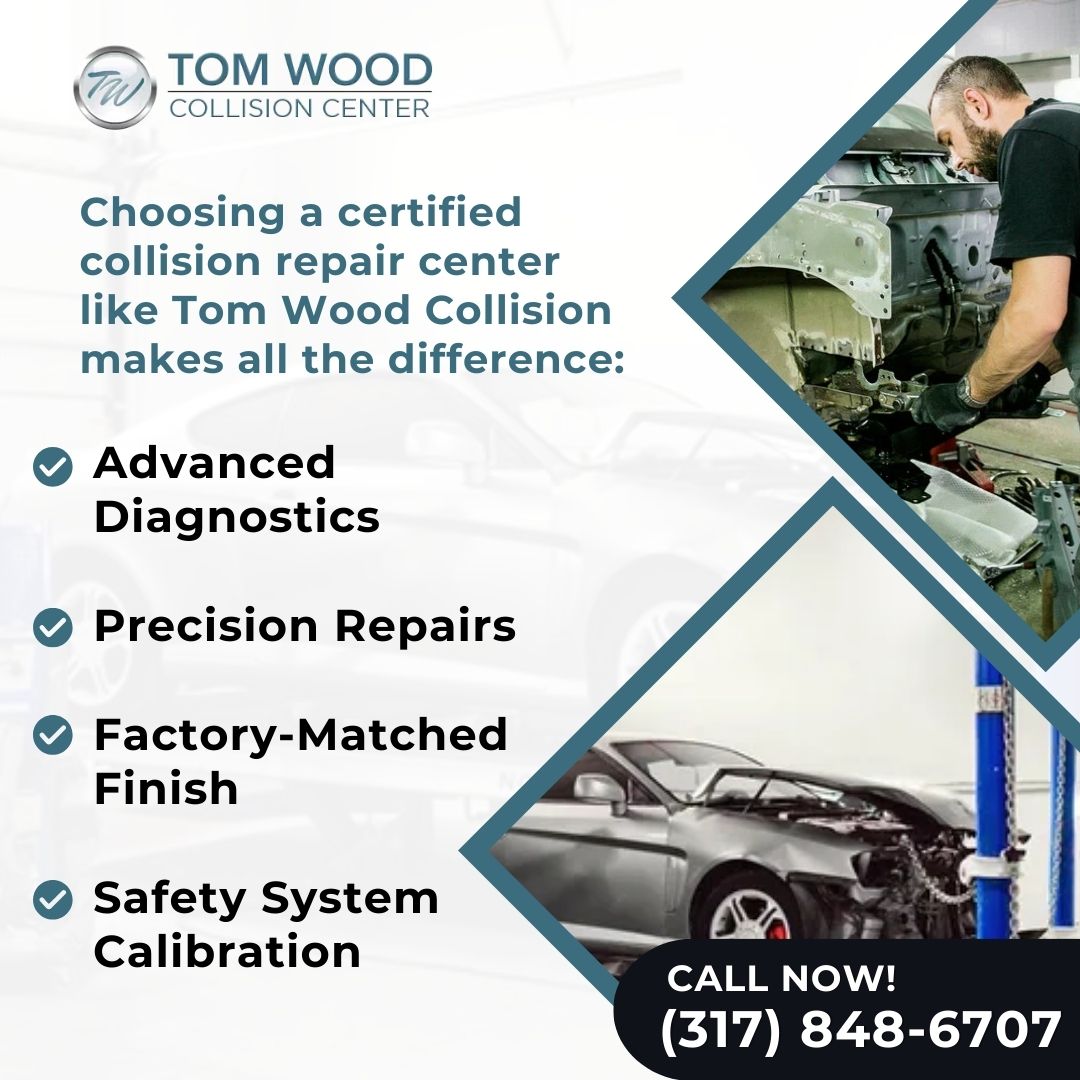
Professional collision repair requires more than basic body work skills. Our facility combines manufacturer certifications, advanced diagnostic technology, and systematic processes that deliver repairs meeting factory specifications. We hold certifications from brands including Porsche, Jaguar, Land Rover, Volvo, Lexus, Honda, Toyota, Ford, and General Motors.
Our technicians maintain current I-CAR Gold Class and ASE certifications through continuous education. Technology investments set our repair capabilities apart. The UVEYE Helios scanning system identifies structural and mechanical damage during initial assessments. Computerized frame measurement guides precise structural corrections. Automated paint mixing delivers consistent color matches.
When you need auto collision repair near you, the facility you choose directly impacts both your safety and satisfaction. Our collision shop follows a systematic approach that addresses every repair aspect from initial assessment through final delivery. We work directly with all major insurance companies to streamline your claims process and reduce the stress of repairs. Whether you've experienced minor damage or need extensive restoration work, our team provides transparent communication and quality results you can trust.
Get Started with Your Collision Repair Today
Contact Tom Wood Collision Center at (317) 848-6707 for your free repair estimate in Indianapolis. Our manufacturer-certified technicians provide the quality auto collision repair near you that restores both your vehicle and your confidence.